
Baby sleep sack and safe sleeping position guidelines
“Is this sleeping position safe?” “Should I immediately adjust the baby if they roll over?” “Will using a baby sleep sack actually make things less safe?”
In fact, infant sleeping position and sleep environment are core issues that have been repeatedly studied and emphasized in the field of infant safety. And a baby sleep sack is one of the key tools connecting “safe sleeping position” and “safe sleep environment.”
Why is “sleeping position safety” more important than you think?
Many parents feel that:
“As long as the baby is asleep, the position shouldn’t be that important, right?”
However, in infancy, sleeping position is not a matter of “comfort” but of “safety.”
Numerous studies have shown that improper sleeping posture is highly associated with the following risks:
- Sudden Infant Death Syndrome (SIDS)
- Accidental suffocation
- Airway obstruction
- Abnormally high body temperature during sleep
And for infants in the 0-6 month stage:
- Neck weakness
- Limited ability to turn over independently
- They have a very weak ability to react to breathing difficulties.
This is why all authoritative parenting organizations place “safe sleeping position” as the top priority in their sleep guidance.
Baby Sleep Sack in Sleep Position Safety
Many parents have two extreme views on baby sleep sacks:
- One group considers it a “security miracle.”
- Another concern is that it “restricts activity and is therefore dangerous.”
In fact, the core value of baby sleep sacks is not “fixing the baby,” but rather—
reducing external sleep risk variables.
Baby Sleep Sack can do the following:
- Replace loose blankets to reduce the risk of covering your face or getting tangled.
- Help your baby maintain the recommended sleeping position during the initial stages of falling asleep.
- Reduce body temperature fluctuations caused by kicking off the covers at night.
A baby sleep sack cannot do the following:
- Completely prevent turning over
- Correct all unsafe sleeping positions
- Replacing parents with sleep environment management
Only by understanding this correctly can you use a baby sleep sack effectively without creating an unhealthy dependency on it.
A Comprehensive Analysis of the Safety of Three Common Baby Sleeping Positions
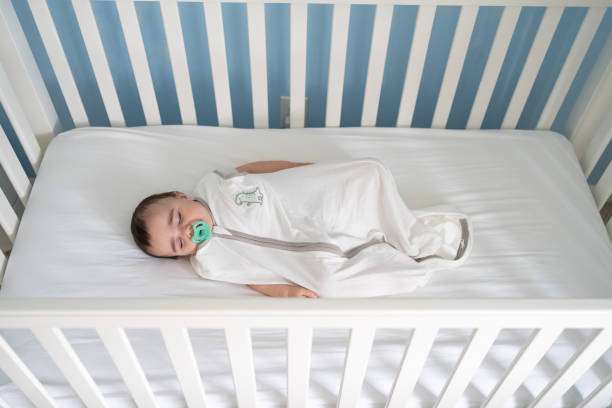
Sleeping on your back: Currently recognized as the “safest choice”
Lying on your back means that the baby is sleeping with their back against the bed and their face up.
Why is lying on your back the safest position?
- Keep the airway open
- The face is not easily covered by the mattress
- Even if the baby spits up, it’s easier for the milk to pass naturally.
- The incidence of SIDS was significantly lower in sleeping positions than in other sleeping positions.
Extensive clinical data has proven that
Consistently sleeping on your back is one of the most effective single sleep safety measures currently available.
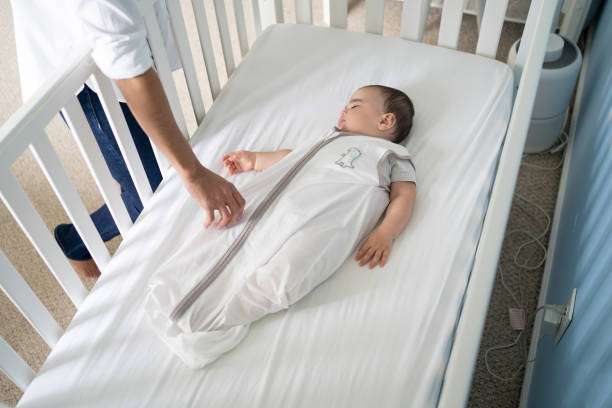
Advantages of supine position + baby sleep sack
- Sleeping bags prevent the blanket from slipping onto your face.
- The shoulder structure reduces the risk of “cramming into the sleeping bag.”
- Babies are more stable during light sleep.
In actual use, you will find that a suitable baby sleep sack can significantly reduce the frequency of your baby squirming and waking up at night.
Prone sleeping position: highest risk, yet most easily misunderstood.
“Prone position” refers to a baby sleeping on their stomach with their face down or to their side.
Many people mistakenly believe that:
“Does sleeping face down make you sleep more soundly?”
However, for infants, the prone sleeping position carries several overlapping risks:
- The face is easily covered by mattresses and sheets.
- Carbon dioxide from respiration may accumulate locally.
- Babies lack sufficient neck strength to adjust their heads.
- The risk of chest and abdominal pressure increases when using a baby sleep sack.
Therefore, it is not recommended to let any infant under 6 months old sleep in a prone position.
Even using a baby sleep sack cannot offset the inherent risks of sleeping on your stomach.
Side sleeping position: It seems like a compromise, but it is actually not stable.
Side sleeping is often considered a safer option than lying on your stomach and more comfortable than lying on your back.
However, the problem is that
Side sleeping is not a stable sleeping position.
- Many babies will roll from their side to their stomach.
- It’s easy to press your face against the bed when turning over.
- Parents may not notice at night.
If a baby is spitting up, doctors may sometimes recommend side-lying for a short period, but this is usually done in conjunction with strict environmental control.
In normal circumstances:
Sleeping on your side should not be a regular sleeping position.
Baby Sleep Sack in conjunction with “safe sleeping positions”?
Sleeping position: Always start by lying on your back.
Whether or not your baby can roll over,
They should always start falling asleep on their back.
The baby sleep sack was originally designed for sleeping on your back.
Sleeping bag size: Much more important than “looks.”
Improper size is one of the most easily overlooked safety hazards associated with sleeping bags.
- Too large: The baby may slip inside the sleeping bag.
- Too small: restricts chest and leg movement.
The safety principle is
- The neckline fits snugly but doesn’t feel tight.
- Shoulder not slip
- There is room for leg movement
Do not stack items inside or outside the sleeping bag.
Many mistakes parents make:
“Wouldn’t it be more reassuring to cover yourself with another thin blanket?”
In fact:
- The baby sleep sack is already the main insulation layer.
- Layering blankets increases the risk of suffocation and overheating.
A sleeping bag plus an empty bed is a safer combination.
Preventing Suffocation: Things You Must Do Besides Your Sleeping Bag
Even when using a baby sleep sack, the following principles should not be ignored:
- Do not put pillows, toys, or mattress protectors on the bed.
- Use a firm, flat mattress
- Maintain room temperature within a reasonable range
- Don’t let your baby wear a hat to sleep
- Regularly check the integrity of the sleeping bag
When I use the baby sleep sack, I make it a habit to quickly check the zipper and neckline when changing diapers at night. This little habit can effectively avoid many potential problems.
Frequently Asked Questions (FAQs) (Questions frequently asked by real parents)
Q1: My baby can already roll over; do we still need to keep him/her on his/her back?
A: You can let your baby roll over freely, but it is still recommended to start with him/her on his/her back when he/she falls asleep each time. The sleep environment should be kept absolutely safe.
Q2: Will a baby sleep sack restrict a baby’s development?
A: A properly sized sleep sack will not affect development; on the contrary, it can reduce sleep interruptions caused by the startle reflex.
Q3: Do I still need to use a baby sleep sack in the summer?
A: You can choose a lightweight and breathable version. The purpose is to replace a blanket, not to keep warm
Q4: Is prone practice the same as sleeping prone?
A: No. Prone practice is necessary when awake, but it is not recommended to sleep prone.
Conclusion:
Baby sleep sacks themselves are not the whole story of safety.
If you are choosing sleep products for your baby,
Prioritize baby sleep sacks that are the right size, have a simple design, and are suitable for the baby’s supine sleeping position.
Starting tonight, establish truly safe sleep habits for your baby.